

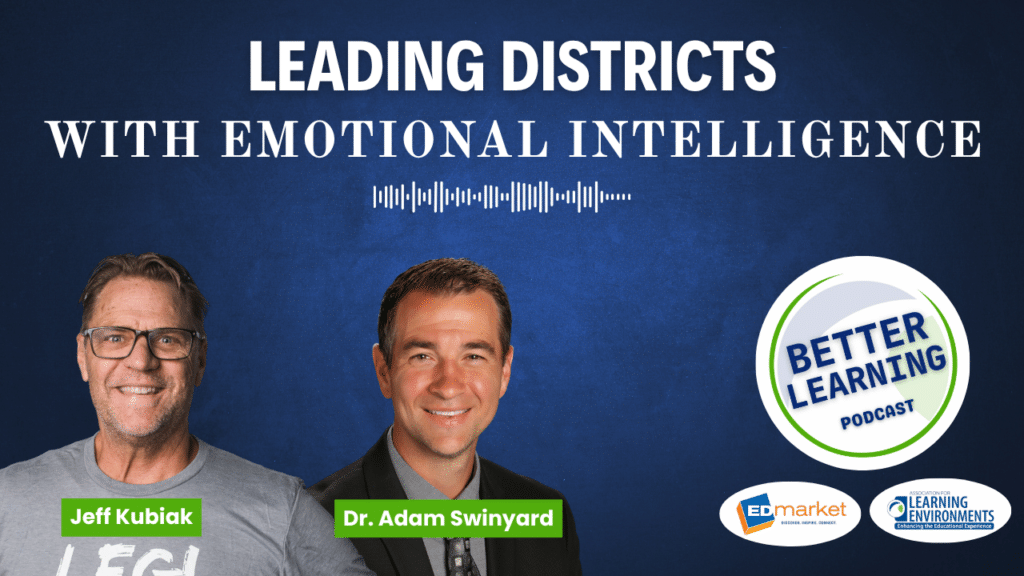
EPISODE 353 with Dr. Adam Swinyard

September 24, 2026
Overview:
Dr. Adam Swinyard, Superintendent of Spokane Public Schools and 2023 Washington Superintendent of the Year, joins the Jeff Kubiak to discuss leading one of Washington’s largest districts through a rapidly shifting information and mental health landscape. Adam shares how Spokane centers everything on relationships, why transparency and “doors and windows” communication have replaced the old top-down model, and how the district’s Engage in Real Life initiative and revised cell phone policy are tackling the youth mental health crisis. He also reflects candidly on lessons learned since becoming superintendent — from the power of emotional intelligence in hiring to rethinking public schools’ role in a world where they no longer hold a monopoly on enrollment.
Meet Our Guest:
About Dr. Adam Swinyard:
The Spokane Public Schools board of directors named Dr. Adam Swinyard superintendent in the summer of 2020. In his role as superintendent for the state’s largest school districts, Dr. Swinyard is tasked with implementing the district’s vision, goals and policies.
Dr. Swinyard previously served as the district’s associate superintendent for teaching and learning and director of secondary schools.
A native of Deer Park, Wash., Dr. Swinyard earned his B.A. in secondary education from Northwest University. He earned his M.Ed, Ed.D in executive leadership, and Washington State Principal and Superintendent credentials from Seattle Pacific University. In 2016, Dr. Swinyard received the Research on Superintendency Dissertation of the Year Award from the American Educational Research Association.
Prior to working in district administration, Dr. Swinyard was the principal at Sacajawea Middle School in Spokane from 2013 – 2016. In that role, he was twice nominated for the Association of Washington School Principals (AWSP) Washington State Middle School Principal of the Year Award. He was an AWSP Regional Principal of the Year winner in 2015. Prior to his time leading Sacajawea, Dr. Swinyard was an assistant principal at Cheney High School in Cheney, Wash., and principal assistant at Garry Middle School in Spokane.
Dr. Swinyard has teaching experience in health and fitness, language arts and social studies in western Washington school districts that include Glacier Peak High School in the Snohomish School District, and McAuliffe Elementary School in Redmond.
Dr. Swinyard and his wife have three children.
Watch on YouTube:
https://youtu.be/uChUFJO172wTakeaways:
- Relationships over hierarchy — Spokane’s culture is built on entering every interaction with love, kindness, and curiosity before power or authority.
- Transparency builds trust — Post-pandemic, families expect “doors and windows” into classrooms; hiding information only invites misinformation.
- Emotional intelligence trumps résumés — Adam prioritizes EQ over traditional credentials when hiring leaders, even for technical roles like HR.
- Engage in Real Life to fight the mental health crisis — Pairing a cell phone policy with real-world clubs, sports, and activities has driven major gains in attendance and behavior.
- Schools no longer have a monopoly — With school choice now widespread, districts must develop real marketing and branding strategies, like higher ed already does.
The Host:
Connect with co-host, Jeff Kubiak:
LinkedIn: https://www.linkedin.com/in/jeffreykubiak/
Learn More About Kay-Twelve:
Website: http://kay-twelve.com/
LinkedIn: https://www.linkedin.com/company/kay-twelve-com/
Instagram: https://www.instagram.com/kay_twelve/
Episode 353 of the Better Learning Podcast
Kevin Stoller is the host of the Better Learning Podcast and Co-Founder of Kay-Twelve, a national leader for educational furniture. Learn more about creating better learning environments at www.Kay-Twelve.com.
Our Partners:
For more information on our partners:
Association for Learning Environments (A4LE) – https://www.a4le.org/
Education Leaders’ Organization – https://www.ed-leaders.org/
Second Class Foundation – https://secondclassfoundation.org/
EDmarket – https://www.edmarket.org/
Catapult @ Penn GSE – https://catapult.gse.upenn.edu/
Read Transcript:
00:00:06.170 –> 00:00:07.200
Jeff Kubiak: All right.
00:00:07.310 –> 00:00:09.460
Welcome to the Better Learning Podcast.
00:00:09.460 –> 00:00:15.420
This is Jeff Kubiak, and I have the distinct honor to be up in, uh, Spokane, Washington today.
00:00:15.880 –> 00:00:17.780
Our guest is, Dr. Adam Swinyard.
00:00:17.890 –> 00:00:24.230
He’s the superintendent of Spokane Public Schools, Washington’s third-largest school district, I believe.
00:00:24.230 –> 00:00:34.810
And among the am- amazing things, uh, Dr. Swinyard’s done, he is the 2023 Superintendent of the Year by the Washington Association of School Administrators.
00:00:34.860 –> 00:00:45.520
Under his leadership, the district has expanded early learning access, driven strong gains in grad rates, all with a consistent focus on equity and belonging for every student and family.
00:00:46.230 –> 00:00:52.610
Dr. Swinyard joins us today to share his perspective on, uh, what’s shaping education here in Spokane.
00:00:52.910 –> 00:00:53.990
Thanks for being here, sir.
00:00:54.000 –> 00:00:54.850
Dr. Adam Swinyard: Yeah, appreciate it.
00:00:54.870 –> 00:00:55.410
Jeff Kubiak: Appreciate it.
00:00:55.587 –> 00:01:02.097
why don’t you give us a little bit of a background, um, maybe just kind of drive us to why you’re here.
00:01:02.127 –> 00:01:04.297
What, what paved this road for you?
00:01:05.743 –> 00:01:22.060
Dr. Adam Swinyard: Yeah, well, I’ve had a meandering path, and I’m not sure too many people set out in the twilight, the dawn of their career and think that the, the end is gonna be involving a, a superintendent anywhere along that road.
00:01:22.550 –> 00:01:25.020
But incredible team in Spokane.
00:01:25.470 –> 00:01:35.182
Love, who we are and what we stand for, and such an honor to stand side by side with so many incredible teachers and staff.
00:01:35.182 –> 00:01:45.386
And what makes Spokane special is, is, uh, every staff member loves their kid, loves the kids like they’re their own, w- what more could you ever want, as a parent when you’re dropping your kid off at school?
00:01:45.526 –> 00:01:46.366
Jeff Kubiak: Yeah, no doubt.
00:01:46.443 –> 00:01:53.523
Wasn’t there a time that you, uh, you taught health and fitness and, um, a, a, a couple different subjects along the way?
00:01:53.603 –> 00:01:54.093
Dr. Adam Swinyard: I did.
00:01:54.093 –> 00:01:57.923
I, I, I did a stint as an el- elementary specialist.
00:01:57.993 –> 00:02:00.723
God bless those people, you know, those classroom teachers.
00:02:00.723 –> 00:02:03.293
You know, they always, uh, drop them off early and pick them up late.
00:02:04.283 –> 00:02:16.258
But I had a great experience doing that, and then also was, in, in health and fitness, social studies, English, and then I was a, a middle school administrator, which is quite possibly the best job on Earth.
00:02:16.548 –> 00:02:17.068
Jeff Kubiak: Yeah.
00:02:17.128 –> 00:02:21.548
It’s, uh, it’s tough work, but it’s, it’s amazing at the end of every day, right?
00:02:21.578 –> 00:02:22.048
Dr. Adam Swinyard: Oh, yeah.
00:02:22.048 –> 00:02:26.638
And, you know, middle school kids are so awesome, and when they say, “I don’t know why I did that,” they’re telling the truth.
00:02:26.638 –> 00:02:26.928
Oh, yeah.
00:02:26.928 –> 00:02:28.568
They literally don’t know why they did that.
00:02:28.578 –> 00:02:34.268
So yeah, it’s … There, there’s big work, but there’s also plenty of, uh, satire there.
00:02:34.348 –> 00:02:34.708
Jeff Kubiak: Yeah.
00:02:34.718 –> 00:02:41.228
So of all the subjects you taught, which is the l- one that you would least want to be quizzed on today?
00:02:41.588 –> 00:02:42.748
Dr. Adam Swinyard: Well, definitely English.
00:02:42.768 –> 00:02:48.132
And you know, I always tell people the time that I spent as a high school English teacher was the hardest
00:02:48.369 –> 00:02:50.959
That is the, the hardest I’ve worked in my life.
00:02:51.399 –> 00:02:58.056
Uh, the amount of hours that goes into being an English teacher, pales in comparison to being a, a, a superintendent.
00:02:58.076 –> 00:03:04.501
So that, that’s … Yeah, don’t quiz me, and, um, man, they have my admiration ’cause that is a, a lot of time.
00:03:04.591 –> 00:03:05.171
Jeff Kubiak: Oh, yeah.
00:03:05.201 –> 00:03:05.831
It’s crazy.
00:03:06.231 –> 00:03:08.481
So you’re a Deer Park guy, right?
00:03:08.481 –> 00:03:08.751
Dr. Adam Swinyard: Yes.
00:03:08.761 –> 00:03:09.381
Deer Park native.
00:03:09.381 –> 00:03:10.031
Yep, small town boy.
00:03:10.121 –> 00:03:14.321
Jeff Kubiak: Yeah, who, uh, spent basically most of your career here, right, in the whole region?
00:03:14.861 –> 00:03:19.331
Dr. Adam Swinyard: Yeah, I … You know, I went to school in the Seattle area, started my career over there.
00:03:19.341 –> 00:03:22.151
Thought I was gonna coach collegiate basketball for a minute.
00:03:22.227 –> 00:03:23.467
met my wife.
00:03:23.467 –> 00:03:31.347
We made it through one season of, of me doing that type of work, and she said, “Uh, is there anything else you can do with your, uh, with your life?”
00:03:31.347 –> 00:03:39.060
So you know, that was, that was really a, a, a blessing to make that pivot and, and really lean into public education.
00:03:39.060 –> 00:03:44.933
And I’ve had some incredible opportunities where mentors gave me leadership opportunities.
00:03:45.013 –> 00:03:54.842
And, um, you know, kinda each step of my road, I was, afforded you know, moments where I could step up and lead in different spaces, and, and, and one, one opportunity led to the next.
00:03:55.092 –> 00:03:55.902
Jeff Kubiak: Yeah, that’s awesome.
00:03:55.912 –> 00:04:04.852
What’s one thing about the school culture here in Spokane that people from, you know, extremely large cities or big urban cities always get wrong?
00:04:05.553 –> 00:04:19.056
Dr. Adam Swinyard: Uh, well, Spokane’s an interesting community in that, you know, we’re, we’re a big small town and so, uh, you know, even though we’re, we’re one of the larger municipalities in the state, uh, w- we’re, we’re not a, a mass metro area.
00:04:19.636 –> 00:04:33.766
And so we, we do have size, but we also have the intimacy of lots of long-standing relationships and connections and, and we often say in Spokane, you know, everybody’s related or was related- … to everyone else at some point in time.
00:04:33.766 –> 00:05:01.292
But it, it really sits at the heart of what makes Spokane special and, and we’re a school district that believe that everything orbits around relationships and that, entering every space with love and with
kindness and with curiosity and, an earnest, authentic desire to respect differences across groups, but while at the same time leaning into, our shared membership a- as a part of the Spokane community.
00:05:01.292 –> 00:05:13.072
So, you know, that’s something we really rel- reinforce, in our school district, something we talk all the time with our teachers, with our parents, with our kids, with our families, is that at the end of the day, everything orbits around relationships.
00:05:13.171 –> 00:05:24.501
Everything orbits around, uh, being loving and kind and, um, and I think that has really been a catalyst to then leading system change and transformation.
00:05:24.502 –> 00:05:43.129
If that sits at the, the center of what you do, then, addressing challenges, addressing conflict, um, managing the, the change process i- is substantively different when relationships are always the focal point a- and our number one priority.
00:05:43.289 –> 00:05:44.049
Jeff Kubiak: That’s wonderful.
00:05:44.129 –> 00:05:56.304
Greatly said and I- it’s funny that now if you can transform yourself back into the eight-year-old version of you sitting, in a public school classroom, what would surprise that eight-year-old the most?
00:05:57.005 –> 00:06:11.570
Dr. Adam Swinyard: I, I think that There’s such diversity of thought and information, and in some ways that, that’s a beautiful thing, and in some ways it creates such incoherence and fragmentation.
00:06:12.370 –> 00:06:20.333
And I think that’s a, a unique challenge for us from a sociocultural perspective, not just inside of our school districts, but, societally, not everybody.
00:06:20.333 –> 00:06:32.134
When I, my, my grandpa was, was the mayor of Deer Park for 20 years, and everything he believed and knew about the world came from the Spokesman-Review, our local newspaper, and that, that was his source of truth.
00:06:32.514 –> 00:06:35.334
now, that, that is radically different.
00:06:35.354 –> 00:06:45.384
People’s source of truth is… could be a mass continuum of podcasts, newspaper, TikTok, traditional broadcast television, you name it.
00:06:45.384 –> 00:06:51.474
It’s such fragmentation of where people go to, to understand the world and develop an opinion.
00:06:51.964 –> 00:07:02.244
And I, I, th- in some ways, again, I, I think that nurtures diversity of thought and perspective, and at the same time, it introduces so much misinformation and so much incoherence.
00:07:02.244 –> 00:07:17.714
And it, it makes it a unique challenge for, for our school system because there are so many misconceptions that, um, metastasize in online spaces and in various pockets because there isn’t that one credible source of truth.
00:07:18.174 –> 00:07:28.654
And we’ve had to really think differently about how we communicate with families, when, how, where, how often, what topics, and when, how, and where we communicate with our community.
00:07:29.134 –> 00:07:40.469
And so y- you know, in some ways that, that has, that has made the classroom more vibrant and dynamic, and in some ways it’s made it more susceptible to conflict and tension.
00:07:40.599 –> 00:07:40.829
Jeff Kubiak: Yeah.
00:07:40.829 –> 00:07:42.389
It’s, it’s an interesting conundrum.
00:07:42.513 –> 00:07:46.173
We went from a silo of limited information-
00:07:46.223 –> 00:07:46.623
Dr. Adam Swinyard: Mm-hmm
00:07:46.633 –> 00:07:49.183
… Jeff Kubiak: right or wrong, but- that was our only belief, right?
00:07:49.193 –> 00:07:49.213
Yeah.
00:07:49.233 –> 00:07:59.299
And now we have the 360-degree panorama of explosive information coming- and what to believe, how to believe, and why to believe it, right?
00:07:59.309 –> 00:07:59.329
Yeah.
00:07:59.339 –> 00:08:09.143
And I, That really does… It messes with our littles’ minds, because they hear 12 things from 12 different people about one subject, right?
00:08:09.193 –> 00:08:09.503
Dr. Adam Swinyard: Yeah.
00:08:09.503 –> 00:08:11.183
Jeff Kubiak: And where do they go?
00:08:11.193 –> 00:08:12.023
Has it been vetted?
00:08:12.033 –> 00:08:12.053
Yeah.
00:08:12.063 –> 00:08:15.593
How do I learn how to vet that- Yeah … and speak for myself and learn, right?
00:08:15.683 –> 00:08:15.973
Dr. Adam Swinyard: Yeah.
00:08:15.973 –> 00:08:26.183
And I, I think that, uh, you know, kids are significantly more perceptive than we give them credit for, and they are significantly more resilient than sometimes we give them credit for.
00:08:26.563 –> 00:08:41.215
And they, even at very young ages, th- pick up on, where there might be gaps in credibility or gaps in trust, that is just a different reality than, you know, back in the day when it was like you trusted the second grade teacher.
00:08:41.335 –> 00:08:46.305
The second grade teacher, you know, s- sent a note home, said you’re doing good in reading, you’re doing good in reading.
00:08:46.525 –> 00:08:50.385
The second grade teacher called home and said you’re in trouble, you’re in trouble.
00:08:50.975 –> 00:08:58.527
Uh, there was such a strong basis of trust between parent and educator.
00:08:58.537 –> 00:09:09.772
A- and now with all these different narratives introduced and all this 360 mass, wave of information all the time, it, it has fractured- Yeah … some of that.
00:09:09.772 –> 00:09:09.782
Right.
00:09:09.782 –> 00:09:19.442
And so w- you know, as a school district, I, I think maybe there’s been some, some spaces, and maybe there’s some systems that are still a little stuck, and they’re, they’re mad and offended by that.
00:09:19.992 –> 00:09:33.682
Whereas I believe in Spokane, we’ve said, “Okay, w- we need to think differently about the cultures that we nurture inside of our schools,
and how people feel when they come in, and how kids feel when they come in, and how parents come- feel when they come in the main office.
00:09:34.262 –> 00:09:44.957
And we need to think differently about how we and what we’re sharing about our school system.” And I’ve really seen that, think we were moving in that direction pre-pandemic.
00:09:45.287 –> 00:09:48.886
Post-pandemic, it accelerated and exasperated that.
00:09:48.896 –> 00:09:57.566
And I always say, you know, people put cameras in their homes because they wanna see what their pet is doing during the day.
00:09:57.996 –> 00:10:11.776
And during the pandemic, during that, that, that flashpoint of online school, people got to see a window into their child’s classroom in a way they never had before, and that expectation didn’t go away when we went back to brick-and-mortar school.
00:10:11.776 –> 00:10:14.306
They still want to see in.
00:10:14.796 –> 00:10:19.266
And so we’ve really tried to emphasize that, that our schools and our classrooms, there needs to be doors and windows.
00:10:19.756 –> 00:10:24.866
There needs to be doors and windows for the communities and families to feel like the school district belongs to them.
00:10:25.286 –> 00:10:26.566
We are their employees.
00:10:26.866 –> 00:10:36.486
We are there to serve them and their students and to provide a learning experience for their kids, and they deserve to see in, and they deserve to come in.
00:10:36.486 –> 00:10:40.456
A- and, and I feel like we’ve been really successful in thinking what that looks like.
00:10:40.456 –> 00:10:50.186
And sometimes it’s just as simple as, you know, making sure that we’re taking pictures and posting them for parents to see of kids smiling, kids having fun at recess, kids eating lunch together.
00:10:50.486 –> 00:10:56.506
They, they want to see that experience, and I think that’s really necessary to cut through some of the other narratives.
00:10:56.506 –> 00:11:02.436
‘Cause if you leave the vacuum empty, then it’s gonna get filled, and school districts have to think differently about that.
00:11:02.666 –> 00:11:11.476
Jeff Kubiak: Yeah, and I think regardless of if you call yourself a community school or not, if you have a school in a community, it is.
00:11:11.496 –> 00:11:18.674
And, and communities must be welcomed, and they must feel that this is the pride of their ownership, right?
00:11:18.674 –> 00:11:18.944
And-
00:11:19.036 –> 00:11:21.686
these are their n- their legacies following- Yeah … right?
00:11:21.686 –> 00:11:34.324
Dr. Adam Swinyard: And, and I think we need a, a recentering in public education to situate with clarity where we are positionally in the school district, where our, our teachers are amazing professionals.
00:11:34.664 –> 00:11:36.394
They deserve that respect.
00:11:36.434 –> 00:11:38.024
They deserve that admiration.
00:11:38.304 –> 00:11:41.480
They deserve professional ways for, for the work that they do.
00:11:42.290 –> 00:11:48.550
And at the all same time, we need to positionally center ourselves on we are their employees.
00:11:49.130 –> 00:11:52.030
They hired us to teach their child to read.
00:11:52.290 –> 00:11:54.710
They hired us to teach their child algebra.
00:11:55.130 –> 00:11:57.200
They deserve to know how that’s going.
00:11:57.630 –> 00:12:04.290
They deserve to see what that looks like, and they deserve to know with validity whether or not we are successful doing that.
00:12:04.811 –> 00:12:14.305
I think that sits at the heart of educators, but I do think that we have, over time, evolved and have gravitated away from being really centered on that.
00:12:14.378 –> 00:12:15.468
That it’s not either/or.
00:12:15.568 –> 00:12:18.168
It shouldn’t be you should be professional.
00:12:18.168 –> 00:12:19.278
You should be respected.
00:12:19.288 –> 00:12:21.718
You should be a- admired for your sacrifice.
00:12:21.768 –> 00:12:25.638
Y- that, yes, and we are their employees.
00:12:25.748 –> 00:12:26.658
It’s not either/or.
00:12:26.658 –> 00:12:27.528
It’s both.
00:12:28.008 –> 00:12:42.108
And, and I think we’ll strengthen the fabric of our public school system and our relationship with families in the communities when
we’re all really clear about the role and the service that we provide, and we provide a service not unlike other public servants.
00:12:42.568 –> 00:12:44.698
You know, it’s, it’s hard to run into a burning building.
00:12:44.858 –> 00:12:46.458
It’s hard to police the streets at night.
00:12:46.498 –> 00:12:50.188
It’s hard to work in the ER room as a nurse, um, on the weekends.
00:12:50.528 –> 00:12:54.478
Like, w- we don’t stand positionally in a different place than them.
00:12:54.478 –> 00:13:08.327
We stand shoulder to shoulder with them, and I, I think us approaching it that way, I think it, I think it strengthens the, the relationship and helps us sense-make in some of those moments in ways that maybe it’s been harder to sense-make in the past.
00:13:08.367 –> 00:13:15.217
Jeff Kubiak: Yeah, and I, I think too bad that school of thought that you just brought up of the shoulder to shoulder isn’t universally embraced.
00:13:15.678 –> 00:13:19.798
uh, because I think as, as a culture, we would do so much better.
00:13:20.228 –> 00:13:20.518
Dr. Adam Swinyard: Yeah.
00:13:20.738 –> 00:13:21.308
Really, we would.
00:13:21.308 –> 00:13:21.438
Jeff Kubiak: I mean,
00:13:21.558 –> 00:13:30.368
Dr. Adam Swinyard: roles of public service deserve our admiration, and we should not put any one of them p- positionally superior to, to, to one or the other.
00:13:30.398 –> 00:13:31.038
They’re all hard.
00:13:31.208 –> 00:13:31.428
Jeff Kubiak: Yeah.
00:13:31.478 –> 00:13:32.028
Dr. Adam Swinyard: They’re all hard jobs.
00:13:32.028 –> 00:13:32.248
Jeff Kubiak: Yeah.
00:13:32.608 –> 00:13:34.428
Dr. Adam Swinyard: And they all provide a service to the community.
00:13:34.458 –> 00:13:34.658
Jeff Kubiak: Right.
00:13:34.688 –> 00:13:35.568
Dr. Adam Swinyard: Um, both are true.
00:13:35.728 –> 00:13:36.308
Jeff Kubiak: Exactly.
00:13:36.318 –> 00:13:41.638
S- so perspective-wise, you, you went… You were an AP, I believe, right?
00:13:41.778 –> 00:13:42.048
Dr. Adam Swinyard: Yeah.
00:13:42.078 –> 00:13:42.198
And
00:13:42.198 –> 00:13:42.898
Jeff Kubiak: a, and a
00:13:42.898 –> 00:13:43.288
Dr. Adam Swinyard: principal.
00:13:43.288 –> 00:13:43.552
Middle school assistant principal, yeah.
00:13:43.552 –> 00:13:43.658
Then principal.
00:13:43.658 –> 00:13:45.988
Jeff Kubiak: Then su- associate su- superintendent.
00:13:47.058 –> 00:13:59.708
The path to superintendency is not always the same, and so what’s- Yeah … one thing you saw from the classroom seat that most or some superintendents never see because maybe they parachuted in from the outside?
00:14:00.505 –> 00:14:19.931
Dr. Adam Swinyard: Something that, that was really valuable to me in my journey is from my, my time as a teacher, my time as assistant
principal, and my time as a, as a principal, was the necessity of being in an organization that, values freedom within structure.
00:14:20.073 –> 00:14:24.853
and always creating and approaching our work from that, from that standpoint.
00:14:24.853 –> 00:14:27.763
That in a classroom there should be freedom.
00:14:28.003 –> 00:14:37.723
There should be, the, the space to really meet the unique needs of kids and what they’re bringing to the table, and their backgrounds, and experiences, and needs.
00:14:37.743 –> 00:14:51.437
And, and that’s the beauty of teaching and the art of teaching i- is really looking at a group and, engaging in that, that cycle of inquiry to say, “What, what pedagogical practices are gonna create the best learning opportunities for kids?”
00:14:51.797 –> 00:15:00.977
While concurrently there being structure that helps us leverage our collective expertise and wisdom, and leverage the efficiency of the resources we have.
00:15:01.095 –> 00:15:08.915
and I learned being in schools the, the power of that at the teacher level and at the building administrator level.
00:15:08.915 –> 00:15:08.925
Yeah.
00:15:08.925 –> 00:15:11.125
And, and I think that’s where w- we get to our best.
00:15:11.125 –> 00:15:18.135
I think systems struggle when we, we get too decentralized, and we struggle when we get over-centralized.
00:15:18.135 –> 00:15:21.621
And r- and really that space we wanna be in is freedom within structures.
00:15:21.621 –> 00:15:28.247
When we’re talking about how we’re using curriculum, we’re talking about, how we’re approaching student behavior, there, there should be some things that are consistent.
00:15:28.247 –> 00:15:39.857
There should be structures that we all, really lean into to create that coherence and consistency, while at the same time leaving space to recognize every kid’s different in every classroom, and every school is a little bit different.
00:15:39.857 –> 00:15:44.831
We have 58 schools and they are all different and they’re all their own unique ecosystems.
00:15:45.343 –> 00:15:50.403
Jeff Kubiak: I, I like the way that you really kind of take on champion of so many different angles.
00:15:50.423 –> 00:15:54.123
And, and I’ve actually read that you’ve been called the champion of equity-
00:15:54.333 –> 00:15:54.523
Dr. Adam Swinyard: Oh
00:15:54.713 –> 00:15:59.461
… Jeff Kubiak: which I think is amazing, for a school district back in the day that wasn’t very diverse.
00:15:59.694 –> 00:16:01.404
And it’s, it’s come a long way.
00:16:01.404 –> 00:16:17.812
So how would you say in the lens of equity has the district approach, kind of student behavior and discipline going from old approach to looking more at data and mental health?
00:16:18.190 –> 00:16:30.653
Dr. Adam Swinyard: Yeah, well it, it’s, it, it is centered on relationships and that, what conditions are necessary for every kid to, to have a sense of belonging in, in school.
00:16:30.743 –> 00:16:33.279
And, Nurturing that sense of belonging.
00:16:33.339 –> 00:16:40.899
There, there’s a school culture component, there’s a curricular component, there is, uh, an activities and athletics component.
00:16:40.899 –> 00:16:52.526
I mean, there, there’s these various elements that, when introduced inside of our school, w- we can really foster the opportunity for every kid to feel like they belong and connected.
00:16:52.526 –> 00:16:54.356
And then I think that’s been a really important part.
00:16:54.356 –> 00:17:01.786
Our Engage in Real Life initiative has been unimaginably successful, where we’ve said every kid, every day, we want them doing something after school.
00:17:02.406 –> 00:17:08.816
And, um, we’ve built a system to do that and, uh, a community coalition to champion it.
00:17:08.836 –> 00:17:14.566
And we just have this explosion of clubs and sports participation and performing arts.
00:17:14.576 –> 00:17:22.096
And lo and behold, there’s a significant correlate between kids that are in those activities and their attendance, their grades, their behavior.
00:17:22.826 –> 00:17:25.376
A- and so it’s about nurturing tho- those conditions.
00:17:25.376 –> 00:17:37.396
I think it’s… W- uh, another really important part of that journey was trying to, again, think and be reflective about where is the school district positionally in the community.
00:17:37.906 –> 00:17:40.146
We, we, we are not the moral authority.
00:17:40.706 –> 00:17:48.376
Um, we are not the hierarchical determinant on how kids should be raised and how they should, they should… what they need.
00:17:48.796 –> 00:17:53.236
Um, that should be co-constructed with the community that we serve.
00:17:53.246 –> 00:18:05.609
And I think sometimes historically, school systems have, engaged their communities and said, “Let, let us tell you what your problem is, and then we’re gonna tell you how to solve it.”
00:18:06.189 –> 00:18:13.929
I think where we have made the most ground in Spokane is meeting with those communities and saying, “How do you want us to love your kid? What does that look like?”
00:18:13.929 –> 00:18:14.309
Jeff Kubiak: Yeah.
00:18:14.669 –> 00:18:21.509
Dr. Adam Swinyard: “And what does success look like for you in your community?” We have a large Marshallese population in Spokane.
00:18:21.509 –> 00:18:25.889
And, and it’s been about going to them and saying, “How do you want us to love your kids?
00:18:26.669 –> 00:18:40.729
And what does success look like in your community from your perspective for your children?” because the school district wants to be a partner in that and wants to understand your perspective in that.
00:18:41.249 –> 00:19:01.813
And I, I think when we started doing that, it, There were some really challenging points because there’s some historical trauma and some historical harm, and there has to be a space
to talk about that and to, to deepen our understanding, uh, of that harm and that trauma, while at the same time saying, “And, and how do you want us to love your kids moving forward?
00:19:02.103 –> 00:19:37.585
And what does that look like, and how do we partner on that, and how do we do that together, and how do we create doors and windows so that you can be a participant in that?” I think there’s some shared ownership
In that, I think there’s school systems that, that, like I said, have entered that space very hierarchically and said, “We know We’re the moral authority and we’re the experts, and we’ll tell you what your kids
need and, and what your role is.” A- and inversely, I think, uh, there’s been some deterioration on some of the psyche of the American family and what their responsibilities are from parents and caregivers.
00:19:38.065 –> 00:19:41.865
And, you know, for example, if, uh, we’ve been talking a lot about sleep health.
00:19:42.295 –> 00:19:51.055
If your, if your student is staying up till 1:00, 2:00, 3:00 o’clock in the morning and you’re dropping them off for school and they’re in third or fourth grade, you’re not dropping them off for school.
00:19:51.195 –> 00:19:51.215
Mm-hmm.
00:19:51.225 –> 00:19:52.735
You’re dropping them off for babysitting.
00:19:52.745 –> 00:19:53.125
Jeff Kubiak: Yes.
00:19:53.305 –> 00:20:03.475
Dr. Adam Swinyard: Because a, a, a child that age and, and younger and older, if, if they only get three or four hours of sleep, like those of us that have kids know what that’s like, right?
00:20:03.495 –> 00:20:04.545
Are they ready to learn?
00:20:04.545 –> 00:20:05.965
Are they ready to follow directions?
00:20:05.965 –> 00:20:09.305
Are they ready to self-regulate, even co-regulate?
00:20:09.315 –> 00:20:09.805
No.
00:20:10.475 –> 00:20:16.875
And so there is a shared responsibility, and a lot of our families are capable of doing that.
00:20:17.205 –> 00:20:33.145
The ones that have barriers that make it challenging for them to fill that space, maybe it’s a work issue, a mental health issue, a, a, you know, a physical health
issue, we should be ready to come alongside those parents, but it doesn’t mean that the school district is solely responsible for, for what happens during the school day.
00:20:33.225 –> 00:20:37.275
Like p- parents have a role to play and caregivers have a role to play in that.
00:20:37.425 –> 00:20:38.235
Jeff Kubiak: Yeah, yeah.
00:20:38.303 –> 00:20:52.512
What, what’s one approach that you use, you and your team for that to come at the parents side by side and walk along with them and not, “This is what you need to do,” but, “Hey, we need your help.”
00:20:52.622 –> 00:20:53.062
Dr. Adam Swinyard: Yeah.
00:20:53.062 –> 00:20:57.152
We, w- we have a, uh, an incredible leader.
00:20:57.242 –> 00:21:31.952
Uh, his name is, uh, Dr. Oscar Harris, just an, an amazing leader of color in our system, and when I became superintendent, uh, we, uh, started a Department of Family and Community Engagement, and one of the col- core functions of that department
is, community liaisons that, that walk hand-in-hand with families as, it’s a complex role, and it’s taken a lot of time to nurture and understand, but they are representing the school district, and they are a parental advocate at the exact same time.
00:21:31.972 –> 00:21:32.272
Jeff Kubiak: Yeah.
00:21:32.682 –> 00:21:49.820
Dr. Adam Swinyard: And, um, that has taken a lot of learning and understanding of how to enter those spaces, how to set up those spaces, how to, create a space where
the family and the child feels supported, but also the administrator, the teacher, our student services department, our special ed, like everybody can share that space.
00:21:50.460 –> 00:21:56.680
Um, but it was really important for families to see a department that was very rooted in the community.
00:21:56.680 –> 00:22:14.861
The staff that work in that department, have really important community connections a- and credibility where they can step into that space and say,
“Hey, you know, if you, if it feels like y- you’re not getting to a resolution with the school, you can call us, and we can step into that space.”
00:22:14.861 –> 00:22:14.871
Right.
00:22:14.871 –> 00:22:33.871
And then the, the last thing that I would say to that is we have really… and I, I said it last week to all of our administrators, um, “In Spokane Public
Schools, we believe in the win-win. We believe in exploring and searching for the win-win,” and that doesn’t mean that in every situation somebody… it’s 50/50.
00:22:33.871 –> 00:22:36.911
And it doesn’t mean that it’s 90/10 one way or the other.
00:22:36.931 –> 00:22:48.234
It means that you care enough about resolution, and you care enough about finding path forward where there’s been some element of power sharing.
00:22:48.244 –> 00:22:53.724
There has been recognition on the feelings and the sentiments and the values of parents and kids.
00:22:54.274 –> 00:23:02.445
We wanna explore what that looks like, and that can easily get misinterpreted as like, ” you’re telling us to just cave- Right … the family, and they’re gonna run the show.” Nope, I’m not saying that.
00:23:02.915 –> 00:23:04.615
Be curious about the win-win.
00:23:04.935 –> 00:23:07.575
Okay, the student is gonna have to receive a discipline.
00:23:07.605 –> 00:23:08.355
Well, okay.
00:23:08.355 –> 00:23:21.374
Well, the parents come in and said, “Gee, they got this going or that going, or how could we…” And it’s not about saying, “Okay, it’s gonna be less of a consequence,” but maybe you find a different consequence that meets a similar s- threshold of, intensity.
00:23:21.444 –> 00:23:21.784
Jeff Kubiak: Yeah.
00:23:22.104 –> 00:23:33.824
Dr. Adam Swinyard: But you’re partnering and co-constructing and looking for the win-win, and so we really try to emphasize that, and I,
I think it’s gone a long ways with family ’cause again, just because you have all the hierarchical power doesn’t mean you should use it.
00:23:34.272 –> 00:23:37.313
And I, I think we really lose our way when we, take that path.
00:23:37.313 –> 00:23:42.193
And that path is usually the most linear and the most simplistic and the closest in time and space.
00:23:42.223 –> 00:23:42.493
Jeff Kubiak: Right.
00:23:42.513 –> 00:23:49.973
Dr. Adam Swinyard: And so systems, especially large ones, can easily default to, “Okay, well I’m just gonna do that because I have the hierarchical power and I can.”
00:23:49.983 –> 00:23:50.003
Yeah.
00:23:50.013 –> 00:23:56.633
Where we’re saying, “No, no, we’re gonna explore the win-win here, and we’re gonna look to repair,” and that does take more time and effort.
00:23:56.773 –> 00:23:57.023
Jeff Kubiak: Yeah.
00:23:57.023 –> 00:24:01.893
And oftentimes with the win-win, it could be just to be listening and acknowledging someone.
00:24:01.993 –> 00:24:02.333
Dr. Adam Swinyard: Absolutely.
00:24:02.343 –> 00:24:02.643
Right?
00:24:02.733 –> 00:24:05.993
Jeff Kubiak: And those are deal makers a lot of the times.
00:24:05.993 –> 00:24:06.223
Yeah.
00:24:06.223 –> 00:24:06.333
Dr. Adam Swinyard: Yeah.
00:24:06.333 –> 00:24:08.213
And, and being willing to own.
00:24:08.363 –> 00:24:08.633
Jeff Kubiak: Yeah.
00:24:08.683 –> 00:24:09.113
Dr. Adam Swinyard: You know?
00:24:09.183 –> 00:24:15.883
I mean, I was with a booster club on Monday, and I was, owning a breakdown in communication.
00:24:15.883 –> 00:24:16.593
That’s on me.
00:24:16.593 –> 00:24:21.523
Every decision, everything that happens in Spokane Public Schools is ultimately my responsibility.
00:24:22.053 –> 00:24:32.793
Um, I was in front of a group of teachers this morning and said, “Hey, that assessment plan we had last year, it did not go the way w- and I am really sorry that that slowed you down from getting…”
00:24:32.823 –> 00:24:35.613
Like, it takes a willingness to be able to own it.
00:24:35.613 –> 00:24:59.683
Like, we really struggled, um, there was just a, a, a r- lot of challenge and turbulence with our families with special needs, and I feel like one of the most important moments, and I’ve
had a lot of families come to me and say this, the turning point is when someone that was the leader of the school district got up and said, “Hey, this is not okay, and this is not working.
00:24:59.853 –> 00:25:10.654
It doesn’t mean teachers don’t love your kid and aren’t giving their best, but this system, this structure is broken and, and it’s not working, and I’m sorry.” a, a willingness to, to be vulnerable goes so far.
00:25:10.734 –> 00:25:11.314
Jeff Kubiak: Yeah.
00:25:11.734 –> 00:25:12.444
Yeah, definitely.
00:25:12.444 –> 00:25:25.074
I, I’ve, as a teacher and a learner, you know, em- embracing, empowering, and really advocating for particular groups i- is super important- Yeah
00:25:25.114 –> 00:25:25.924
when they don’t feel heard, right?
00:25:25.924 –> 00:25:26.254
Dr. Adam Swinyard: Yeah.
00:25:30.997 –> 00:25:35.777
You know, when we work with schools at K12, it’s not just about furniture or design, it’s about impact.
00:25:36.017 –> 00:25:40.187
Our radically student-centered approach puts students at the center of every decision.
00:25:40.497 –> 00:25:48.577
From that first conversation to the final walkthrough, we’re focused on creating spaces that actually work for the kids, the teachers, and the community.
00:25:48.857 –> 00:25:52.627
So if you’re looking to do more than just check a box on your next project, let’s talk.
00:25:52.877 –> 00:26:02.847
Visit k12.com, that’s K-A-Y-T-W-E-L-V-E.com, and see how we’re helping schools transform learning one student at a time.
00:26:03.187 –> 00:26:07.227
Because at K12, it’s not just about projects and furniture, it’s about purpose
00:26:12.432 –> 00:26:14.042
Jeff Kubiak: So you’re, you’re about five years in.
00:26:14.142 –> 00:26:14.432
Dr. Adam Swinyard: Yeah.
00:26:14.452 –> 00:26:14.732
Jeff Kubiak: Right?
00:26:14.732 –> 00:26:28.868
And so this is the Better Learning Podcast, and what is- You know, Adam Swinyard, a belief you had on day one, and what, what have you completely reversed and kind of learned better?
00:26:29.297 –> 00:26:31.697
Dr. Adam Swinyard: Oh, well, there, there’s a, there’s a lot of those.
00:26:31.892 –> 00:26:34.072
I’ll kind of rattle off a, a handful of them.
00:26:34.072 –> 00:26:38.012
One is, uh, when I first became superintendent, I thought I could do my own calendar.
00:26:38.072 –> 00:26:52.952
Like, I thought I was gonna be like- … this super hip and cool millennial, and, like, I didn’t need anyone doing my calendar, and
I was unimaginably wrong- … um, about that, and I’m, I’m so grateful for the, the, the teammates that I have that help me in that.
00:26:53.170 –> 00:27:08.407
I also thought that I was gonna come in and create, like, this super cool, like, utopian central office structure that was, like, totally flat and, you know, very, vibe and y- you know, millennial and it’s gonna be awesome.
00:27:08.407 –> 00:27:11.877
You know, we’re all just gonna, like, you know, wear Birkin socks and- Yeah … lock arms.
00:27:11.877 –> 00:27:12.257
Kumbaya.
00:27:12.257 –> 00:27:13.607
Yeah, yeah, it’s gonna be awesome.
00:27:14.077 –> 00:27:23.549
Um, and, and I, I did learn over time that, Hierarchical structures are necessary in big systems.
00:27:23.969 –> 00:27:31.169
What’s most important is that you hire emotionally intelligent leaders that understand when and how to use their hierarchical power.
00:27:31.369 –> 00:27:32.549
Like, that- that’s what matters.
00:27:32.549 –> 00:27:32.869
Yeah.
00:27:33.239 –> 00:27:36.299
Creating a structure with no hier- hierarchy doesn’t work.
00:27:36.678 –> 00:27:37.728
you need that.
00:27:38.018 –> 00:27:45.098
Um, you, you need it on the day-to-day, you need it in a crisis, you, you need it to, to make a system this size be efficient.
00:27:45.436 –> 00:28:03.106
I, where I think we have really found deep value is anyone who wants to be a leader in Spokane Public Schools, we believe needs to,
um, have a strong foundation of emotional intelligence and be willing to learn and grow on how to be more emotionally intelligent.
00:28:03.146 –> 00:28:21.066
And, you know, not everybody, uh, prescribed to that word and, and, and that’s okay, and I would say a little differently of y- you need to be able to recognize your own feelings and
emotions, and recognize the feelings of others and their emotions, and then be able to use that to build the biggest, broadest, strongest coalitions possible to move work forward.
00:28:21.166 –> 00:28:21.526
Jeff Kubiak: Yeah.
00:28:21.526 –> 00:28:25.536
Dr. Adam Swinyard: Uh, and I, I think that really sits at the heart of, of leadership.
00:28:25.536 –> 00:28:30.196
So that, that was, you know, really important learning along the way.
00:28:30.571 –> 00:28:37.552
and then, and then I’d- I’ve learned a lot about, what it looks like, and then we’ve talked a little bit about this already, just communicating what, what it looks like for
00:28:37.862 –> 00:28:41.352
the, in the 21st century for a school district to communicate.
00:28:41.362 –> 00:28:45.622
When I, when I started at our communications department had a pretty small footprint.
00:28:46.232 –> 00:29:05.913
We did kind of the prototypical things, we quickly learned that in order for us to build that powerful coalition that is needed to, position our schools,
our teachers, and our kids to be the most successful possible, w- we needed to create our own media outlet inside of our, of inside of our district.
00:29:05.923 –> 00:29:06.303
Jeff Kubiak: Right.
00:29:06.393 –> 00:29:08.713
Dr. Adam Swinyard: Um, and so we do content creation.
00:29:08.713 –> 00:29:11.173
We have, you know, people that specialize in social media.
00:29:11.173 –> 00:29:28.773
We do paid, you know, digital advertising to get our community the information they deserve, um, and they need to then foster a coalition to say,
“We’re, we’re all working together. Um, it’s in everybody’s best interest that our kids are educated and ready to become productive citizens.”
00:29:28.833 –> 00:29:35.723
And, you know, that’s just something on day one I’d, I’d, I would have never guessed that that would be such a significant part of our work.
00:29:35.923 –> 00:29:43.353
Jeff Kubiak: Yeah, and I, I think the importance of having a good communications leader, like someone I know very… you know, I’ve met here before.
00:29:43.733 –> 00:29:54.419
But having the objectivity to show this is who Spokane Public Schools is, instead of having A very niche far left, far right news anchor- Yeah
00:29:54.499 –> 00:29:54.649
right?
00:29:54.919 –> 00:29:55.149
Yeah.
00:29:55.149 –> 00:29:56.439
Sharing what they want.
00:29:56.459 –> 00:29:56.699
Dr. Adam Swinyard: Yep.
00:29:56.859 –> 00:30:00.172
Jeff Kubiak: And what we talked about earlier was, the source of information, right?
00:30:00.172 –> 00:30:06.778
And so when your chief of communications is, is spreading the truth, the love, the joy, the mishaps-
00:30:06.778 –> 00:30:07.138
Dr. Adam Swinyard: Yep.
00:30:07.138 –> 00:30:07.348
Yep
00:30:07.378 –> 00:30:09.918
… Jeff Kubiak: makes a big difference for the community to wanna jump in and join.
00:30:09.918 –> 00:30:10.138
Dr. Adam Swinyard: Yeah.
00:30:10.138 –> 00:30:13.798
It makes a big difference, and you, you have to be accessible.
00:30:13.978 –> 00:30:14.248
You know?
00:30:14.248 –> 00:30:21.128
So every two weeks we do a media availability, and a- any member of the media can come, and they can ask any question they want.
00:30:21.568 –> 00:30:23.808
Um, they don’t have to, they don’t have to give us any prep.
00:30:23.828 –> 00:30:25.868
They don’t have to tell us what they’re gonna talk about.
00:30:26.298 –> 00:30:34.167
That vulnerability and transparency ha- has, has built, I think, a, a lot of trust with our media partners.
00:30:34.187 –> 00:30:46.230
And, um- think that, that every school district needs to understand what their marketing and branding strategy is, and that is very different radical thinking for school districts.
00:30:46.240 –> 00:30:53.610
For, I don’t know, the last 200 and ish years, we have had a complete monopoly on enrollment.
00:30:54.020 –> 00:30:56.230
Um, and that’s varied a little bit by state, obviously.
00:30:56.240 –> 00:30:56.370
Sure.
00:30:56.640 –> 00:31:01.240
But, you know, predominantly, public schools have… Like, we’ve had a monopoly.
00:31:01.400 –> 00:31:02.700
Like, where do kids go to school?
00:31:02.750 –> 00:31:03.900
They go to the public school.
00:31:03.910 –> 00:31:04.030
Yeah.
00:31:04.440 –> 00:31:14.647
And, um, you know, th-there’s lots of things that are great about that, but the world has, has changed, and choice and options is here.
00:31:14.917 –> 00:31:18.347
It’s not going anywhere, and public schools no longer have a monopoly.
00:31:18.447 –> 00:31:22.247
The neighborhood school no longer is the only choice and the only option.
00:31:22.697 –> 00:31:30.687
And so now public schools are, are going to have to become aware, not unlike some of our higher ed or many of our higher ed pro- They, they’re familiar with this.
00:31:30.737 –> 00:31:42.437
They’ve been marketing and branding their universities for, for decades- Yeah … because th-they don’t have a monopoly, and there’s
choice in higher ed, and they’re trying to, you know, promote what their school has to offer and what’s great about their school.
00:31:42.437 –> 00:31:49.517
A-and so we, we’ve had to move into that space and say, “We have an amazing story to tell.”
00:31:49.787 –> 00:32:03.807
There are great things happening in our schools, and we have to have a marketing and branding strategy to share that information with our families and our communities, A, because we work for them, and B, we want them to be able to see what’s happening.
00:32:03.807 –> 00:32:16.647
And, and that’s just new and different thinking than I think school districts have had before, and, and I think it’s really important
that, that superintendents and district leaders start asking themselves that, like, “What is our marketing and branding strategy?”
00:32:16.657 –> 00:32:20.767
Which then leads you to the next logical question, is what do your customers want?
00:32:20.767 –> 00:32:21.087
Jeff Kubiak: Right.
00:32:21.227 –> 00:32:21.587
Exactly.
00:32:21.617 –> 00:32:23.587
Dr. Adam Swinyard: And we should already be asking ourselves that question.
00:32:23.587 –> 00:32:23.597
Yeah.
00:32:23.597 –> 00:32:23.607
Yeah.
00:32:23.607 –> 00:32:28.626
100%. And if we’re not doing what our customers want, then we should be aligning to, what their expectations are.
00:32:28.626 –> 00:32:41.556
And, and we know that varies, you know, urban, rural, suburban, what, what our families want and what our community wants from our
schools and the type of programs, programs w- they want emphasized and the type of activities they want their kids to have access to.
00:32:41.676 –> 00:32:42.016
Jeff Kubiak: Yeah.
00:32:42.026 –> 00:32:48.423
Something pretty universal now that’s going on is, um, you’ve, I think embraced the work of, uh, Jonathan Haidt.
00:32:48.660 –> 00:32:52.710
so, you know, youth mental health, like pretty meaty territory, right?
00:32:52.720 –> 00:32:53.040
Yeah.
00:32:53.214 –> 00:33:02.054
let’s talk about what you’ve learned from him in regard to technology and kids and phones and things.
00:33:02.764 –> 00:33:10.664
Dr. Adam Swinyard: You know, it’s just, it’s amazing how the world changes, and when I first started in the district, there was a, a big push of bring your own device.
00:33:11.154 –> 00:33:11.694
Jeff Kubiak: Oh, yeah.
00:33:11.964 –> 00:33:16.594
Dr. Adam Swinyard: And then we’ve come all the way to the other end to say- … no one’s bringing any devices- Nothing … to school.
00:33:16.784 –> 00:33:22.643
I think what really sits at the heart of it for us is, you know, mental health in the United States was getting better in the late ’90s.
00:33:22.713 –> 00:33:26.333
When you look at, you know, a variety of metrics, like youth wellness was improving.
00:33:26.963 –> 00:33:33.070
And, you know, as Dr. Hite, you know, points out, in 2008 w- w- we see, a shift in those trends.
00:33:33.471 –> 00:33:50.442
Reasonable to, to address a variety of antecedents to that shift, but, um, certainly technology, and I think there’s empirical research that is,
um, continuing to emerge that says that the use of personal devices and kids’ time online have subsequently changed the childhood experience.
00:33:50.842 –> 00:33:52.472
We started seeing this in the 2010s.
00:33:52.582 –> 00:33:54.312
We started seeing engagement change.
00:33:54.772 –> 00:34:00.792
The pandemic didn’t cause disengagement and isolation, but it, it accelerated and exasperated it.
00:34:01.292 –> 00:34:15.032
And as we came out of the pandemic, and we’re observing and, and hearing lots of concerns from kids and families and staff about mental health issues, that really led us to a point of introspection to say, “What can we practically do as a community?”
00:34:15.572 –> 00:34:19.712
And we really built our strategy around really thr- three core pillars.
00:34:19.712 –> 00:34:21.512
One was, we need to learn together.
00:34:21.642 –> 00:34:21.762
Jeff Kubiak: Yeah.
00:34:22.022 –> 00:34:23.562
Dr. Adam Swinyard: And we did a community book study.
00:34:23.912 –> 00:34:29.732
Uh, we offered, uh, um, Screenagers, which is a, is a great documentary- Fantastic, yeah … viewing to our families.
00:34:29.962 –> 00:34:33.022
We did a lot of learning together to raise awareness.
00:34:33.022 –> 00:34:35.472
It was our own public awareness campaign.
00:34:36.162 –> 00:34:39.042
And then we coupled that with a revised cell phone policy.
00:34:39.042 –> 00:34:43.592
We were the f- the, the first of the large districts in our state to, to take that step.
00:34:44.092 –> 00:34:54.076
And then the third leg of that stool, which, which we really believe w- is such a critical part of the secret sauce, is our Engage in Real Life initiative.
00:34:54.386 –> 00:35:05.446
So that we’re saying to kids, “Hey, no devices at school, and when you go home, instead of being on your device for six, seven, eight hours a day,” which is what some of the research is saying is happening, “hey, we want you be in a club.
00:35:05.736 –> 00:35:10.650
We want you to play a sport.” Because- The reality that they’re not gonna use the devices all…
00:35:10.660 –> 00:35:13.060
Like, we’re, we’re not gonna be able to take all the devices, right?
00:35:13.210 –> 00:35:13.520
Jeff Kubiak: Yeah.
00:35:13.580 –> 00:35:30.680
Dr. Adam Swinyard: But if we can shrink the amount of time that they have that they’re on those devices, and we can replace it with positive, healthy
activities with their peers and positive adult role models, then that’s a practical step that we can make as a community, and it’s, it’s been wildly successful.
00:35:31.110 –> 00:35:35.190
And y- you know, I mean, the reality of it is y- y- we love our mental health therapists.
00:35:35.190 –> 00:35:37.490
We’re the largest mental health provider in Spokane County.
00:35:37.800 –> 00:35:43.010
We have amazing counselors, but, but there aren’t enough people or money to have a therapist with every kid.
00:35:43.120 –> 00:35:43.330
Jeff Kubiak: Yeah.
00:35:43.390 –> 00:36:03.530
Dr. Adam Swinyard: And so we really do need to step back and think about the tiers of intervention and say, you know, some, uh, some kids are gonna need a therapist, for sure, but what are the interventions that we can provide
and what are the universal experiences we can provide to keep as many kids as possible in tier one, keep as many possible kids as tier two, and then we can really concentrate the resources on the kids that need it the most.
00:36:03.540 –> 00:36:03.730
Jeff Kubiak: Yeah.
00:36:03.730 –> 00:36:05.390
That’s, that’s such a great perspective.
00:36:05.390 –> 00:36:09.810
So it… You’ve got the, um, the Dr. Swinyard wand, right?
00:36:09.882 –> 00:36:12.872
This is your generation right now of using technology.
00:36:12.872 –> 00:36:23.091
What’s one thing you think schools can do alone to actually move the needle even more than what your after-school programs are doing right now.
00:36:23.471 –> 00:36:24.531
Is there something bigger?
00:36:25.065 –> 00:36:54.275
Dr. Adam Swinyard: you know, I, I think where I’m, I’m really curious with technology and I’m really curious with AI is how can we leverage AI from both a teacher perspective and a student perspective
to create efficiencies around the learning process and the teaching process, and then reallocate that time into relationships, collaborative experiences, discourse, critical problem-solving?
00:36:54.535 –> 00:36:56.785
How can we reallocate that time?
00:36:56.785 –> 00:37:01.205
And so it’s not, as we’re targeting to talk about teachers, like how are you using AI to lesson plan?
00:37:01.205 –> 00:37:09.945
I think if you’re an educator and you aren’t thinking about how you’re using AI to lesson plan, I, I think there might be some missed opportunities there.
00:37:09.975 –> 00:37:15.325
Because I wonder not about investing less time in the teaching and learning process.
00:37:15.365 –> 00:37:18.365
I’m curious about how we’re using that time.
00:37:18.375 –> 00:37:18.395
Yeah.
00:37:18.405 –> 00:37:37.145
So maybe instead of spending three hours writing that lesson plan, I’m leveraging AI to pull in standards, pull in different ways to differentiate, pull
in different resources, and then I’m taking that time and I’m reinvesting it in calling home and touching base with families or conferencing with kids.
00:37:37.312 –> 00:37:41.672
I, I think that’s where I’m really curious, and I think that’s where the opportunity is.
00:37:41.672 –> 00:37:54.142
And, and, and so I hope we don’t… I hope it doesn’t become lost in, well, AI’s here to just make kids’ lives easier and teachers’ lives easier so that they’re not, they don’t, then they don’t wanna work as hard.
00:37:54.172 –> 00:37:54.442
Jeff Kubiak: Right.
00:37:54.852 –> 00:37:56.382
Dr. Adam Swinyard: I don’t think that’s what we’re talking about.
00:37:56.412 –> 00:38:03.042
I think what we’re talking about is how do we use technology to make the teaching and learning process richer and deeper and more relational?
00:38:03.102 –> 00:38:03.402
Jeff Kubiak: Right.
00:38:03.402 –> 00:38:10.579
And so we have a group of adults that Are also having to learn, how do I create better prompts?
00:38:10.649 –> 00:38:12.069
How do I ask better questions?
00:38:12.069 –> 00:38:12.369
Yeah.
00:38:12.519 –> 00:38:16.489
How do I learn what to ask when building these lesson plans?
00:38:16.489 –> 00:38:16.809
Yeah.
00:38:17.159 –> 00:38:25.759
And so where does that come from when you have a group of, you know, 20, 30 veteran teachers that don’t have that?
00:38:26.319 –> 00:38:26.799
Dr. Adam Swinyard: Yeah.
00:38:26.944 –> 00:38:40.737
I think that this technology evolution, and, and something that I, I, I love that Dr. Haidt said is, you know, let… We have maybe been too much of tech, tech optimists, like tech’s gonna solve all of our problems- Right
00:38:40.737 –> 00:38:46.177
and all of our training can do everything, and we probably should be more in the tech skeptic space.
00:38:46.687 –> 00:38:50.120
Not that tech doesn’t have a role, and, and I sometimes hear that.
00:38:50.120 –> 00:38:55.480
They’re like, “Well, why you, you, you spend so much time talking about screens and getting kids off screens, but yet you have laptops?”
00:38:55.480 –> 00:39:05.640
I’m like, “Yes, of course we do.” Like, it’s a powerful tool, but we should be skeptical of its role, and we should be judicious in the role that it plays.
00:39:05.650 –> 00:39:17.907
A- it is a really exciting opportunity because I do think AI makes technology tools even more accessible to more educators that have a variety of backgrounds and experiences with tech.
00:39:18.187 –> 00:39:29.757
Whereas maybe before you, you had a wider paradigm of some teachers that were really, really leveraging it, a group that was doing, maybe the standard, and then a group that was like really didn’t leverage it at all.
00:39:29.977 –> 00:39:39.327
I do think AI opens up some, some, some opportunities for some groups that maybe didn’t have or feel like that was a space for them to be in.
00:39:39.327 –> 00:39:41.263
So I, think there’s an opportunity there.
00:39:41.943 –> 00:39:47.713
I think that school districts, there’s such a metastasizing of all these different tools and resources.
00:39:47.713 –> 00:39:56.306
I think that’s a challenge for school leaders- Yeah … and, and for principals and teachers, is there’s now all these tools, there’s all these generative, you know, platforms.
00:39:56.596 –> 00:39:57.626
Which one do you use?
00:39:57.636 –> 00:39:58.726
How do you use it?
00:39:59.032 –> 00:40:17.732
and so I’m excited for there s- to be some, some coalescing around that and some coherence around like, hey, the, the, these are, these are off-the-shelf tools you
could leverage or for a district like ours, you know, with your current, you know, suite of technology tools, here’s how you can create some of those on your own-
00:40:17.752 –> 00:40:18.022
Jeff Kubiak: Right
00:40:18.032 –> 00:40:20.272
Dr. Adam Swinyard: to make them very specific to your, to your district.
00:40:20.322 –> 00:40:36.737
And we have a team doing that, where they’re, they’re creating lesson plan agents that we’re able to set, you know, guardrails on what data can it
access, what curriculum can it access, as compared to, to some of the more open generative tools where you, it’s, you don’t know where it’s pulling- Right
00:40:36.747 –> 00:40:37.907
you don’t know how it’s pulling it, you know.
00:40:38.144 –> 00:40:41.624
I, I think that’s gonna be some of the big work and the challenge for districts to sort that out.
00:40:41.634 –> 00:40:42.054
Jeff Kubiak: Sure.
00:40:42.154 –> 00:40:42.544
Yeah.
00:40:42.734 –> 00:40:49.394
So one of the things that we, uh, a term that we use on this podcast is radically student-centered.
00:40:49.655 –> 00:40:52.505
so many different variations, thoughts, iterations, whatever.
00:40:52.517 –> 00:40:57.127
what’s Adam Swinyard’s definition of radically student-centered?
00:40:57.589 –> 00:41:12.875
Dr. Adam Swinyard: I, I think radical is an interesting word because being student-centered really s- to me sits at the heart of the dream of American public education, and it’s, it’s a dream that’s different than any other industrialized world’s dream.
00:41:12.905 –> 00:41:25.375
It’s a dream that says, “No matter who you are, no matter where you come from, no matter what your background is, no matter what challenges
you face, there is hope for you to have a bright and successful future, and we believe that education is a pathway for you to do that.”
00:41:25.385 –> 00:41:28.715
Like, that, that is the dream of American education.
00:41:29.094 –> 00:41:35.034
I, I think there is unimaginable virtuosity in that dream, and I think we have a lot to be proud for, proud of.
00:41:35.034 –> 00:41:42.404
I, I think we serve all in a way that no one else in the world serves all, and I think we should be really proud of that.
00:41:42.454 –> 00:41:49.622
And so, I, I think radical is an interesting term given that is at the heart of the dream of public education.
00:41:49.622 –> 00:41:51.012
Not that we have achieved it-
00:41:51.351 –> 00:41:53.991
I guess in comparison to the rest of the world, it is a radical dream.
00:41:54.201 –> 00:41:58.161
Jeff Kubiak: Yeah, and I think, you know, looking at it, radical doesn’t have to be far out.
00:41:58.201 –> 00:41:59.311
It could be imperative.
00:41:59.331 –> 00:42:00.421
It could be well-thought.
00:42:00.431 –> 00:42:00.451
Yeah.
00:42:00.461 –> 00:42:02.091
It could be purposeful, right?
00:42:02.101 –> 00:42:02.121
Yeah.
00:42:02.131 –> 00:42:07.891
And so I, I think the old term radical, you know, from the ’60s and ’70s, that’s-
00:42:08.001 –> 00:42:09.561
that’s what the first thing people think, right?
00:42:09.571 –> 00:42:10.031
Yeah,
00:42:10.121 –> 00:42:17.171
When you, I think, frame it with student interests and student agency
00:42:17.635 –> 00:42:18.515
where do you go, right?
00:42:18.515 –> 00:42:19.205
Dr. Adam Swinyard: Yeah, yeah.
00:42:19.225 –> 00:42:26.103
I think as I reflect on that, radical is a good way to describe the American dream for public education.
00:42:26.413 –> 00:42:38.283
I mean, when you look at other parts of the world, even industrialized countries, I mean, we welcome every single kid into our school regardless of background, regardless of disability.
00:42:38.743 –> 00:42:43.702
every kid is welcome, and every kid has, the opportunity to, to grow.
00:42:43.712 –> 00:42:43.732
Yeah.
00:42:43.742 –> 00:42:46.432
And that, that is a radical dream in comparison.
00:42:46.722 –> 00:42:47.192
Jeff Kubiak: Sure.
00:42:47.312 –> 00:42:49.092
Dr. Adam Swinyard: Um, and s- I think we should be really proud of that.
00:42:49.152 –> 00:42:49.722
Jeff Kubiak: I do too.
00:42:50.162 –> 00:42:56.478
What, what’s a risk, that you took as a superintendent that you were fully prepared to be wrong about?
00:42:56.991 –> 00:43:07.901
Dr. Adam Swinyard: a, a big risk was believing that emotional intelligence is the most significant factor in leadership success.
00:43:07.901 –> 00:43:16.339
When I first became superintendent, not unlike other superintendent transitions, l- lot of vacancies, sometimes that is a, is a reason they move on.
00:43:16.679 –> 00:43:22.089
Sometimes it’s, uh, people are like, “Well, this is a natural time for me to retire.” So I inherited quite a few vacancies.
00:43:22.308 –> 00:43:24.708
one of those vacancies was our chief HR officer.
00:43:24.788 –> 00:43:26.428
We have s- 6,000 employees.
00:43:26.488 –> 00:43:34.048
We’re the third largest employer in Spokane County behind the Air Force Base and our, uh, our primary healthcare, uh, entity.
00:43:35.018 –> 00:43:46.998
And, uh, we hired our… Uh, we have a, a leader in our district who was an elementary counselor, and then she was a student service coordinator, and then the director of student services.
00:43:47.638 –> 00:43:59.556
And within the first, I th- it was, like, first week or two, I hired her to be our chief HR officer because she has the most unimaginable emotional intelligence of any person I’ve ever met.
00:43:59.566 –> 00:43:59.586
Wow.
00:44:00.256 –> 00:44:30.386
And, and I believed philosophically that if your senior leaders are emotionally intelligent and they can understand the, the labor relation dynamic, and they understand the community dynamic, and they can understand the, the human dynamic of HR, um,
that the, the tier, the management tier within that department that does have the technical expertise, that knows about LNI, that knows about OSHA, that knows about r- you know, all the things, that, that that can be a really successful combination.
00:44:31.186 –> 00:44:38.026
And, um, I’ll never forget, I, I got a phone call and, and, uh, it was like, “Uh, are, are you sure you know what you’re doing?
00:44:38.356 –> 00:44:42.156
Because you have no experience as a superintendent.
00:44:42.586 –> 00:44:44.216
We’re in the middle of a pandemic.
00:44:44.786 –> 00:44:48.546
Is this the time for this type of ex- experiment?”
00:44:48.699 –> 00:44:53.453
And, and I just felt like this is what I believe as a leader.
00:44:53.913 –> 00:45:04.803
And if you, um, spend your time as a superintendent trying to keep your job instead of doing your job, then eventually you’ll fail.
00:45:05.222 –> 00:45:10.972
it’s been a blessing that that worked out, and we have followed that methodology into other leadership positions.
00:45:10.972 –> 00:45:17.082
And that, that has been a risk because draconian practices would say, “Well, what’s their expertise and what’s their education?”
00:45:17.412 –> 00:45:25.552
And we have said, those matter, but what matters more is their emotional intelligence and who they are as a leader.
00:45:25.552 –> 00:45:30.892
And so we used to, in our district, we would never hire an intern straight into a principal job.
00:45:30.972 –> 00:45:31.302
Jeff Kubiak: Right.
00:45:31.442 –> 00:45:32.552
Dr. Adam Swinyard: And we do that all the time now.
00:45:32.602 –> 00:45:32.942
Jeff Kubiak: Yeah.
00:45:33.032 –> 00:45:41.632
Dr. Adam Swinyard: Because, uh, it… That education experience is an important variable, but it is not the most important variable in Spokane Public Schools, and that was, that was a risk.
00:45:41.712 –> 00:45:42.502
Jeff Kubiak: Yeah, that’s great.
00:45:42.512 –> 00:45:53.129
So, when you leave your superintendency and you look back on your legacy, what is one thing you hope that no future superintendent will be able to undo?
00:45:53.688 –> 00:45:56.758
Dr. Adam Swinyard: I d- I don’t really think about it in terms of, of legacy.
00:45:56.758 –> 00:45:59.288
I’ve, I’ve never really contemplated that.
00:45:59.308 –> 00:45:59.888
Um-
00:45:59.928 –> 00:46:02.118
Jeff Kubiak: Unfortunately, you’re gonna leave a legacy.
00:46:02.648 –> 00:46:09.878
And it’s gonna be whatever y- however you wanna look at it, but people are gonna understand, “Oh yeah, Dr. Swinyard, XYZ,” right?
00:46:10.347 –> 00:46:11.737
Embrace that task.
00:46:11.747 –> 00:46:12.547
That’s wonderful.
00:46:13.697 –> 00:46:14.187
Dr. Adam Swinyard: Yeah.
00:46:14.197 –> 00:46:33.638
I, I think the, the one thing that I hope, that it’s vibrant today and, and you’re, you’re always pursuing it, and I hope that it continues to be vibrant after I’m gone, They feel a deep sense of care and a deep sense of ownership in the school system.
00:46:34.258 –> 00:46:38.708
I hope the teachers feel a deep sense of care and a deep sense of ownership.
00:46:38.718 –> 00:46:43.748
I hope that community leaders feel a deep sense of care and a deep sense of ownership.
00:46:43.868 –> 00:46:53.865
I hope that we have and will continue to nurture this environment where it’s not just a job, it’s not just a paycheck, it’s not, a district of schools.
00:46:53.915 –> 00:46:57.345
It’s, it’s a school district, and people are proud to be a part of it.
00:46:57.755 –> 00:47:00.335
They, they care about it, and they have deep ownership.
00:47:00.985 –> 00:47:03.325
Jeff Kubiak: Well, I’m glad this is recorded ’cause that was fantastic.
00:47:03.575 –> 00:47:04.495
You can hang your hat on that.
00:47:05.323 –> 00:47:06.503
I, I just wanna thank you.
00:47:06.553 –> 00:47:08.393
This has been a fantastic conversation.
00:47:08.403 –> 00:47:08.433
Oh, yeah.
00:47:08.633 –> 00:47:08.723
I appreciate
00:47:08.723 –> 00:47:08.823
Dr. Adam Swinyard: it.
00:47:08.833 –> 00:47:08.853
Um,
00:47:09.193 –> 00:47:16.703
Jeff Kubiak: those of you out there listening, if this is something you, uh, are getting something out of, our Better Learning Podcast, share it with your friends, family.
00:47:17.103 –> 00:47:23.123
But, um, it’s been a pleasure having Dr. Adam Swinyard, Superintendent of Spokane Public Schools.
00:47:23.173 –> 00:47:28.423
And, um, hope you have an amazing day, and keep doing what you’re doing because you’re doing it right, sir.
00:47:28.573 –> 00:47:28.843
Dr. Adam Swinyard: Awesome.
00:47:28.843 –> 00:47:29.003
Yeah.
00:47:29.013 –> 00:47:29.633
Thanks for your time.
00:47:29.663 –> 00:47:30.163
Jeff Kubiak: Thank you.
00:47:32.281 –> 00:47:36.741
The Better Learning Podcast is produced by Matt Rogers and edited by Kelly Jones.
00:47:37.421 –> 00:47:46.791
The views and opinions shared on this podcast are those of the individuals speaking and do not necessarily represent the perspectives of their affiliated companies, organizations, or associations
Be a Guest on the Better Learning Podcast!
Are you rethinking what learning environments can be? We are always looking for thoughtful school leaders, designers, and educators to join the Better Learning Podcast and share real stories from the field.
As a guest, you will take part in meaningful conversations about student centered design, planning, and collaboration and how these ideas show up in real schools. We explore what is working, what is evolving, and what educators can do today to create learning spaces that truly support students and teachers.
If you are passionate about improving learning environments and have insights, experiences, or lessons to share, we would love to have you on the podcast.
Better Learning Podcast Request Form
"*" indicates required fields
About the podcast
Through in-depth conversations, the podcast highlights how Radically Student Centered™ approaches can make a tangible difference in schools, inspiring educators, administrators, designers, and anyone passionate about the future of learning.